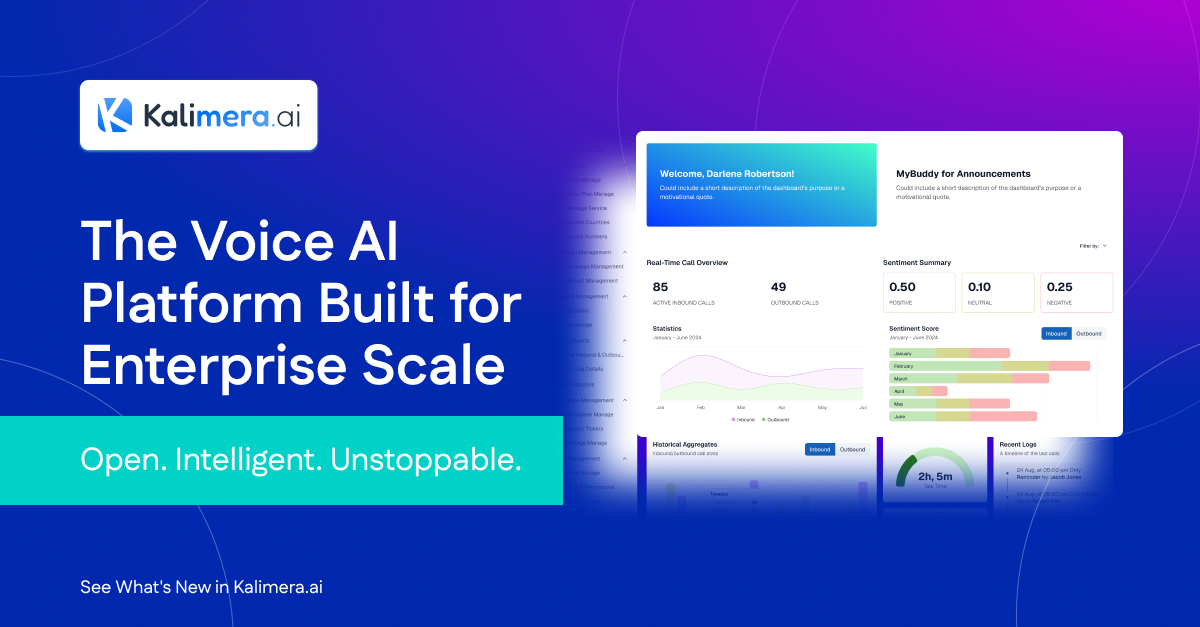
The voice AI landscape is evolving fast and Kalimera.ai just raised the bar. With its latest product release, Kalimera.ai delivers a suite of powerful upgrades designed to make enterprise-grade voice AI more portable, intelligent, and scalable than ever before.
Whether you’re building customer service automation, intelligent IVR systems, or omnichannel communication workflows, this release addresses the real-world challenges businesses face when deploying AI voice agents at scale.
“Open, portable, fully interoperable.” – That’s not just a tagline. It’s the foundation of everything Kalimera.ai shipped in this release.
What’s New in Kalimera.ai: A Complete Feature Breakdown
Here’s a deep dive into every feature shipped in Kalimera.ai’s latest release, and why each one matters for enterprise voice AI deployments.
1. Portability & Transparency
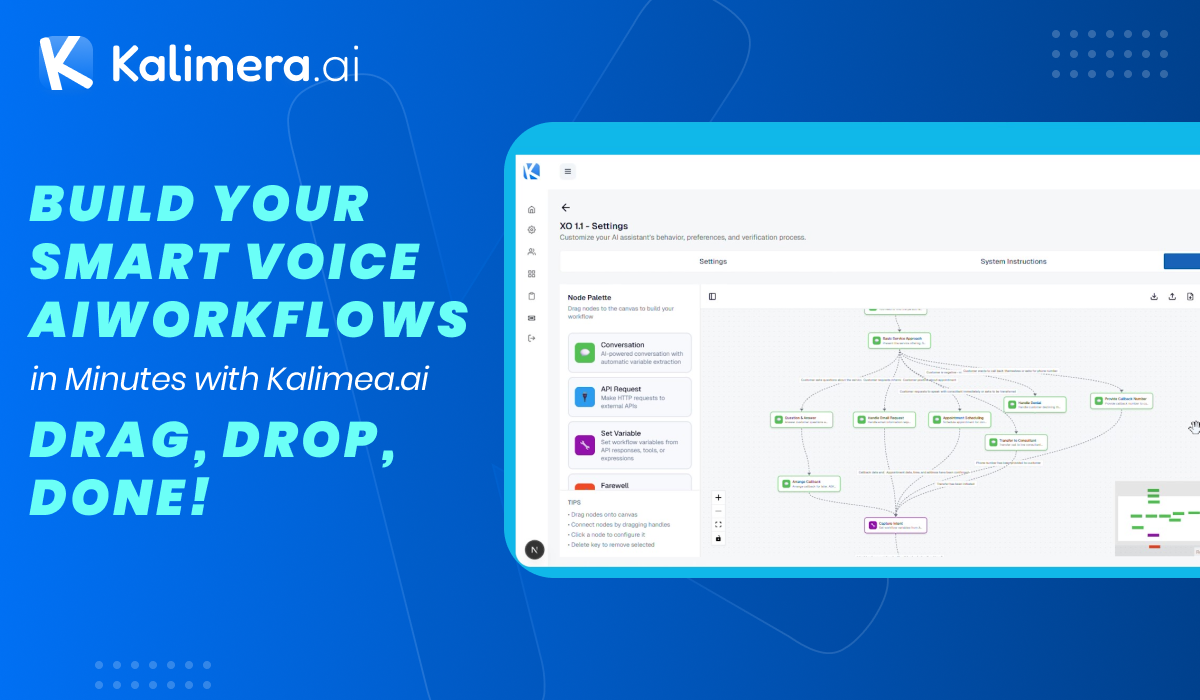
Vendor lock-in is one of enterprise AI’s biggest hidden costs. Kalimera.ai eliminates it by building voice agents on YAML and LangChain — open, portable, and fully interoperable.
Your agents are exportable, auditable, and yours. Switch infrastructure. Migrate systems. Integrate freely. No rebuilding from scratch.
For regulated industries and enterprise IT teams, this isn’t a nice-to-have — it’s a requirement.
2. Enhanced Workflow Engine — AI That Knows When to Step Aside
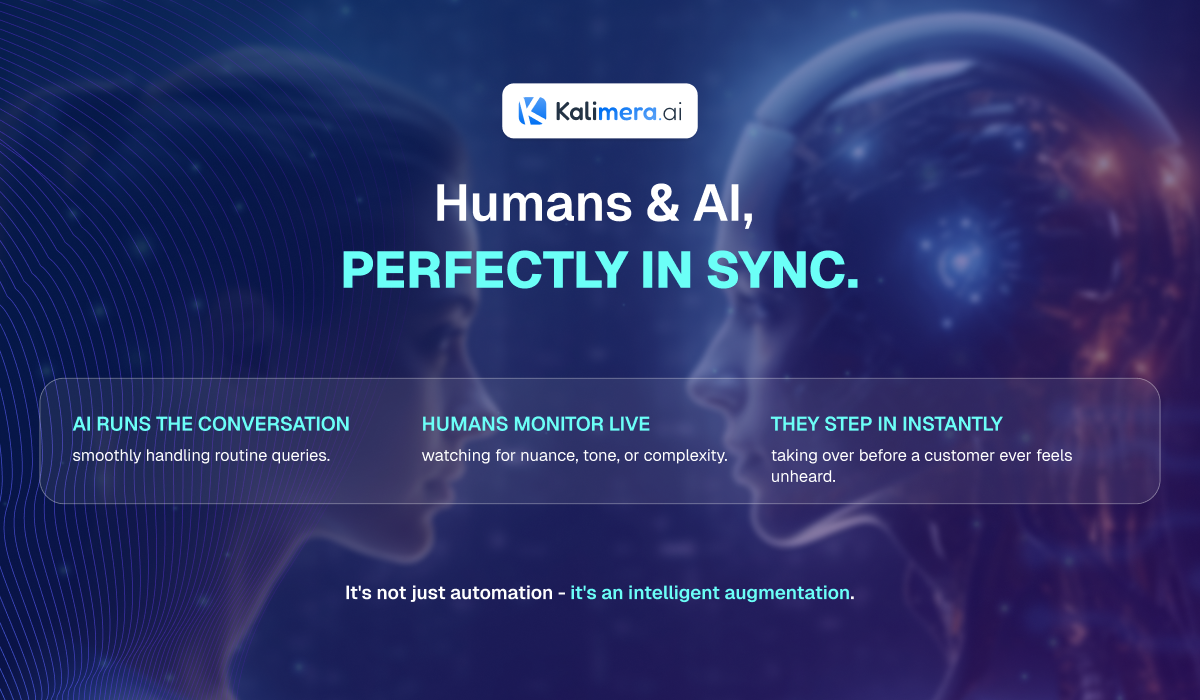
Frustrated callers stuck in bot loops is a conversion killer. Kalimera.ai’s upgraded engine detects emotional signals mid-conversation and hands off to a human agent at exactly the right moment — with full context intact.
The result? Fewer dropped calls, higher resolution rates, and a customer experience that actually feels intelligent.
When CX is your competitive edge, this feature pays for itself.
3. Advanced Post-Action Mechanism — Automate Everything After the Call
What happens after a conversation ends is just as important as the conversation itself. Kalimera.ai’s new Post-Action Mechanism automatically triggers downstream workflows the moment a call concludes — zero manual effort required.
Use cases include:
- Sending automated follow-up SMS or email notifications
- Pushing call data to CRM systems like Salesforce or HubSpot
- Triggering backend workflows such as ticket creation or order updates
This feature closes the loop between conversational AI and business operations — turning every interaction into an actionable data event.
4. Data Maturity & Validation Framework — Enterprise-Grade Quality Assurance
For Voice AI to be credible at enterprise scale, it needs robust testing and performance measurement. Kalimera.ai’s new Data Maturity & Validation Framework delivers exactly that, with three core components now live:
- Dynamic Agent Evaluation: Auto-generated test cases derived directly from live interactions, ensuring your agents are continuously benchmarked against real usage
- Voice AI Agent Testing (A/B Framework): Run parallel agent variants and measure performance differences with statistical rigor
- Reporting & KPI Evaluation: Track agent performance against your defined business goals — not just generic metrics, but the KPIs that matter to your team
This framework positions Kalimera.ai as one of the few Voice AI platforms offering a full-cycle quality pipeline out of the box.
What’s Coming Next: Kalimera.ai’s Product Roadmap
The current release is just the beginning. Kalimera.ai has already committed to its next wave of features, all currently in active development and testing.
1) New STT & TTS Capabilities — Including Gujarati and More Language Support
Kalimera.ai is expanding its speech-to-text (STT) engines with enhanced language detection, alongside broader text-to-speech (TTS) support — including Gujarati, a language spoken by over 60 million people globally.
This expansion signals Kalimera.ai’s commitment to building truly multilingual voice AI, not just English-first solutions with tacked-on translation layers.
2) Performance Improvements — Parallel Polling for Speed at Scale
The engineering team is implementing parallel polling across STT, TTS, and LLM layers simultaneously. The result: significantly faster response times and higher throughput, especially under load.
For contact centers handling thousands of concurrent calls, this architectural improvement directly translates to better caller experience and lower infrastructure costs.
3) Two-Way Telephony (2-Way Trunking) — Enterprise Telephony at AI Scale
Kalimera.ai is among a small number of AI companies globally that manage up to 2,000 internal phone numbers directly through AI, with support for complex dial plans including busy signals, absence routing, refusal-to-talk handling, and more.
This positions Kalimera.ai not just as a voice AI layer, but as a full telephony infrastructure partner for enterprise clients.
4) Out-of-the-Box PBX API + Enterprise Integrations
Campaign management is getting a major upgrade with contact list handling via PBX API. Kalimera.ai will also offer native integrations with Qualco and OpenCom CTI — two widely used platforms in European enterprise telephony and collections management.
These integrations reduce deployment time from weeks to hours for qualifying customers.
5) Omnichannel Approach — One Platform, Every Channel
Perhaps the most ambitious item on the roadmap: a true omnichannel voice and messaging platform. Kalimera.ai is building unified coverage across:
- Calls/Phone (inbound & outbound)
- Chat (web and in-app)
- WebSocket integrations
- Email automation
- And more channels in development
This positions Kalimera.ai as a single-platform solution for businesses that need consistent, intelligent customer communication across every touchpoint.
Why Kalimera.ai’s Approach to Voice AI Stands Out
The enterprise Voice AI space is crowded. What differentiates Kalimera.ai isn’t any single feature — it’s the architectural philosophy behind the platform:
- Open and portable: YAML + LangChain means you own your agents
- Quality-first: A/B testing and dynamic evaluation baked in from day one
- Operationally complete: Post-action automation bridges AI and business workflows
- Globally capable: Multilingual support including underserved languages like Gujarati
- Enterprise-ready: Telephony infrastructure, PBX API, and CTI integrations for large-scale deployments
Voice AI that can’t be validated, tested, or integrated into real business systems isn’t enterprise AI — it’s a demo. Kalimera.ai is building the alternative.
Final Thoughts: Is Kalimera.ai the Right Voice AI Platform for Your Business?
If your organization is evaluating Voice AI platforms for customer service, outbound calling, or omnichannel communication, Kalimera.ai’s latest release deserves serious consideration.
The combination of open architecture, intelligent escalation, automated post-call workflows, and a rigorous quality framework addresses the full lifecycle of enterprise voice AI — from deployment to optimization.
With a roadmap that includes multilingual TTS, parallel processing performance gains, and native enterprise integrations, Kalimera.ai is clearly building for scale — not just for demos.
Stay ahead of the curve in conversational AI. Follow Kalimera.ai’s product updates to see how Voice AI is being redefined for the enterprise.