If you’ve been in business long enough, you’ve probably lived this cycle:
A rush of new customers comes in. Support tickets pile up. Someone says, “We need more agents.” You hire. Things stabilize — briefly. Then it all starts again.
It’s not a people problem. It’s a model problem.
The way most companies think about scaling customer support hasn’t fundamentally changed in decades. More customers = more headcount. But in 2025, that equation is quietly breaking down — and the companies winning at customer experience have already figured out why.
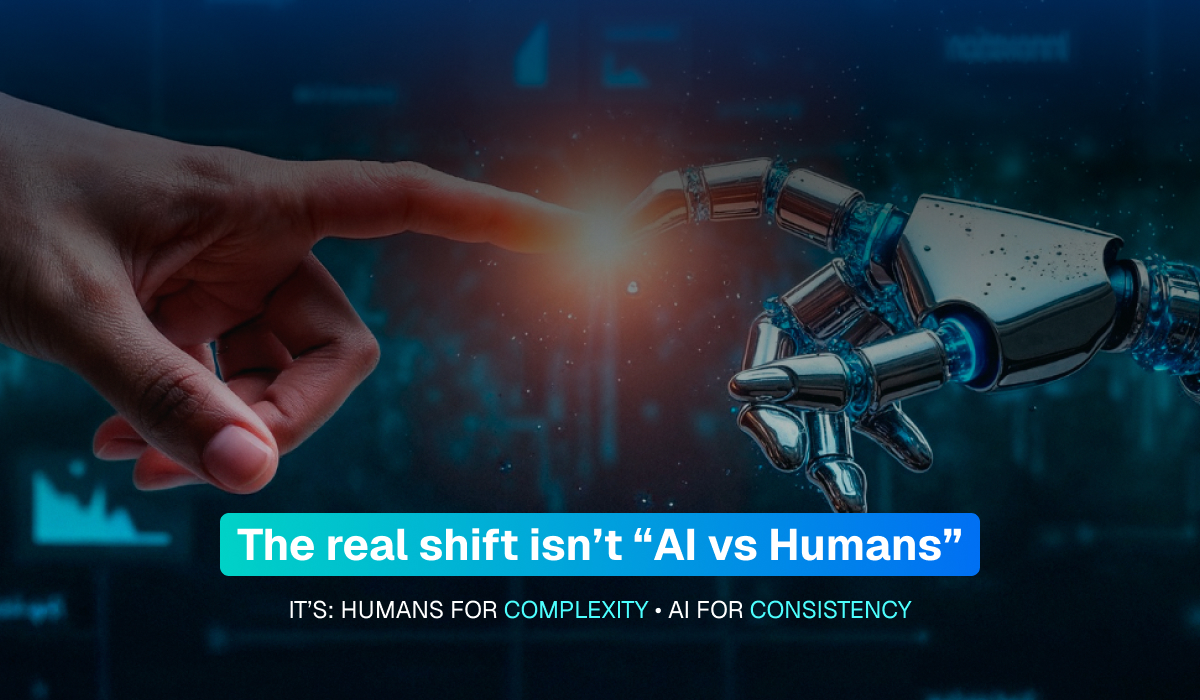
The real question isn’t whether to use AI or keep humans. It’s understanding what each does best — and building a system that plays to both strengths.
Let’s unpack this properly.
The Traditional Support Scaling Model — And Why It’s Cracking
For most of business history, scaling support meant one thing: hiring.
More customers arrive → hire more support agents → capacity increases. Simple, linear, familiar.
And it worked — until the cracks started to show. Here’s what inevitably happens when you scale purely with headcount:
- Costs grow faster than revenue
Human agents are expensive. Not just salaries — onboarding, training, management overhead, attrition, and re-hiring. The bigger your support team, the steeper that curve.
- Quality becomes inconsistent
Twenty agents means twenty different interpretations of your brand voice, twenty different ways of handling a frustrated customer, and twenty different levels of product knowledge. Consistency is almost impossible to maintain at scale without enormous investment in training and QA.
- Burnout is real
Customer support is one of the most emotionally taxing roles in any company. High-volume, repetitive queries — password resets, order status, billing questions — drain your best people, leading to mistakes, disengagement, and eventually turnover. It’s a cycle that quietly destroys team morale.
None of this means human agents aren’t valuable. They are — enormously so. But they’re being asked to do work that doesn’t require their best qualities. And that’s the real problem.
What AI Actually Does Well in Customer Support
Before we talk strategy, let’s be honest about what AI can and can’t do — because the hype in both directions tends to miss the nuance.
AI-powered support tools (think chatbots, virtual agents, automated ticketing systems) are genuinely exceptional at:
- Consistency:
AI gives the same accurate answer at 2 PM and 2 AM. It doesn’t have bad days.
- Volume:
AI handles thousands of simultaneous conversations without any degradation in response time.
- Memory:
AI doesn’t forget your return policy, your product specs, or what it said three messages ago in the same conversation.
- Speed:
Instant responses for common queries mean faster resolution times and higher CSAT scores for routine issues.
- Availability:
24/7, 365, across time zones — without overtime pay.
These aren’t small advantages. For the 60–70% of support interactions that are predictable, repetitive, and information-based, AI isn’t just “good enough” — it’s often better than a tired, distracted human agent working their 40th ticket of the day.
“AI doesn’t get tired. AI doesn’t forget. AI doesn’t make mood-based decisions.” — That’s not a threat to your support team. That’s a feature you should be leveraging.
.
The Smarter Framework: Humans for Complexity, AI for Consistency
This is the shift that’s quietly happening at the companies winning on customer experience right now.
Instead of asking “AI or humans?” — they’ve reframed the question:
“Which type of interaction requires human judgment, and which one benefits from machine consistency?”
It sounds simple. But operationalizing it requires intentional design:
- Map your interaction types
Not all support tickets are equal. Start by categorizing your incoming volume: What percentage is routine (FAQs, order tracking, password resets)? What percentage is complex or emotionally sensitive? This data shapes your automation strategy.
2. Build intelligent routing
The best hybrid support systems don’t just answer tickets — they triage them. AI handles what it can resolve fully. Anything else gets escalated to a human with full context already loaded, so the agent isn’t starting from scratch.
3. Use AI to augment, not just replace
Even in human-handled tickets, AI can help: surfacing relevant knowledge base articles, suggesting responses, flagging sentiment shifts, tracking SLA timers. Your human agents become faster and more consistent — without burning out.
4. Measure what matters
Resolution time, CSAT, first-contact resolution rate, escalation rate — these metrics tell you where your hybrid model is working and where it needs tuning. Data drives continuous improvement.
Why This Shift Is Happening Now
AI-powered support tools have matured significantly in the last two to three years. Large language models can now handle nuanced, multi-turn conversations with far more accuracy than earlier chatbot generations. Natural language understanding has improved to the point where AI can detect intent, sentiment, and context in ways that weren’t possible even in 2021.
At the same time, customer expectations have risen. People expect faster responses, personalized service, and consistent experiences across channels. The traditional headcount model simply cannot deliver all three simultaneously — not at scale, not sustainably.
The economics have also shifted. AI tools that were once enterprise-only are now accessible to mid-market and even small businesses. The barrier to implementing a thoughtful AI-human hybrid model has dropped dramatically.
The question isn’t whether this transition will happen across the industry. It’s already happening. The question is whether you’re building a system ahead of the curve or scrambling to catch up.
The “AI vs Humans” framing was always the wrong debate. It was never a competition.
The smartest companies don’t see AI as a replacement for their support teams. They see it as infrastructure — the system that handles volume, consistency, and availability at scale — so their human team can focus on what actually requires human judgment.
Humans for complexity. AI for consistency.
That’s not a compromise. That’s a better system than either could build alone.
If your support operation is still running purely on headcount, it’s worth asking: what’s the ceiling on that model? And more importantly — how far are you from hitting it?
The companies winning at customer experience today didn’t get there by hiring faster. They got there by thinking differently about what their people are for.
Want to See How This Works in Practice?
Kalimera.ai is built around exactly this philosophy — combining the reliability of AI with the empathy of human support to create experiences that actually scale without sacrificing quality.
See it live at Kalimera.ai
Leave a Reply